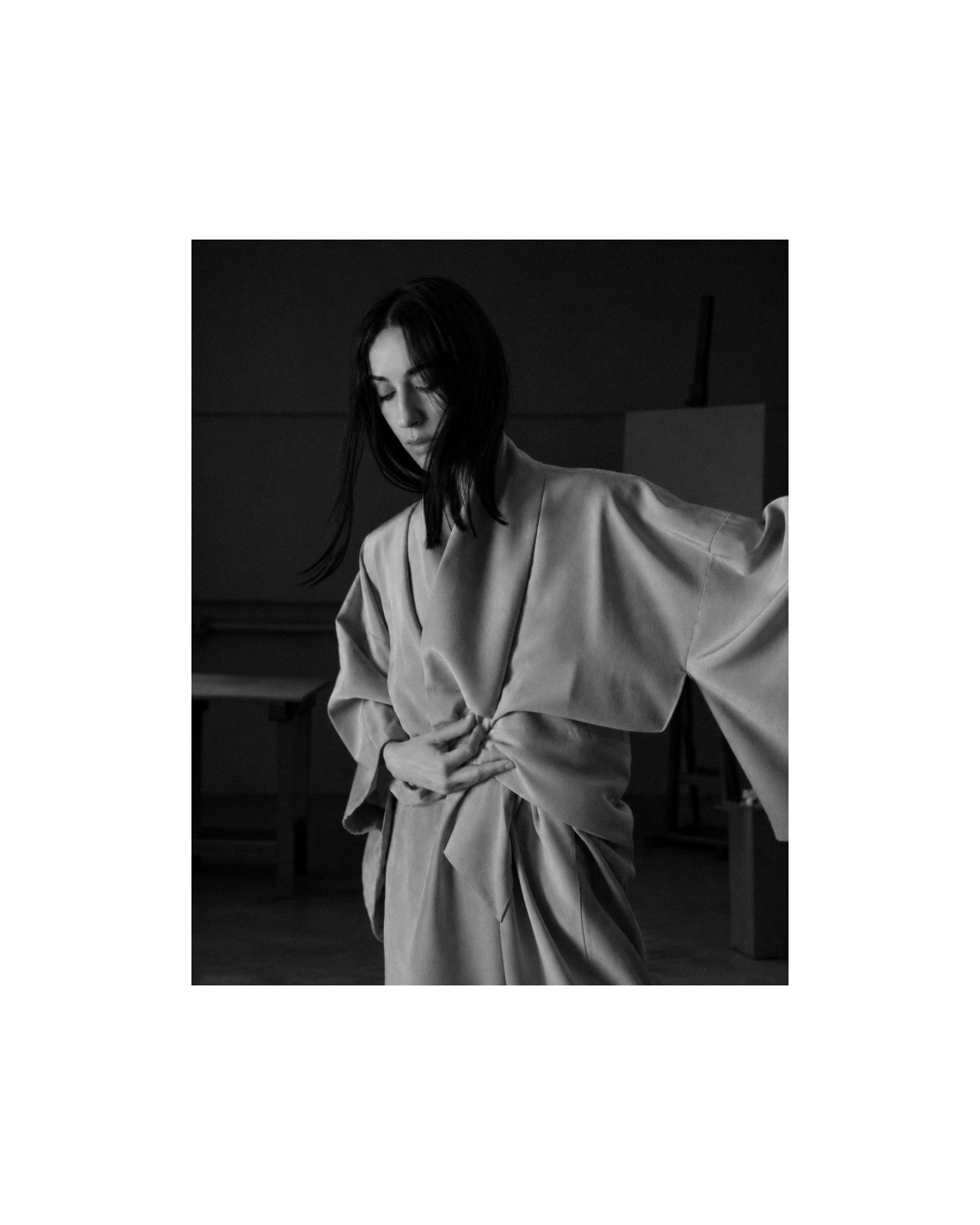
Sophia Ippoliti was born in Umbria, Italy and currently lives in Rome, working between the city and her studio in the Umbrian countryside. A self-taught artist, she has developed her distinctive visual language through the exploration and experimentation of different art forms, from photography to painting on wood and textiles. Her practice reflects a continuous curiosity for materials, textures and the expressive possibilities of unconventional surfaces, bringing together a personal sensitivity and an instinctive approach to image-making.
Her ongoing studies are deeply influenced by a longstanding fascination with Japanese aesthetics and calligraphy. Her travels to Japan are an integral part of this research, offering opportunities to deepen her understanding of its visual traditions, artistic philosophy and relationship with form, gesture and space. These influences continue to inform her evolving practice, inspiring a dialogue between material, image and the subtle beauty of imperfection.
“My artistic practice begins as a form of personal meditation, an intuitive flow of thoughts, spontaneous gestures and unpredictable movements that take shape through colour and material. I approach the creative process as a space of openness and surrender, allowing instinct and chance to guide the emergence of each work.
As a self-taught artist I have moved through different phases of exploration and experimentation, gradually developing the visual language that defines my practice today. Ink has become a central element in this journey, particularly its behaviour across different surfaces and its ability to generate unexpected forms, layers and trajectories. Its movement is never entirely predictable, it becomes an active presence within the work, a fluid matter that both records the gesture and resists control.
I see this process as a reflection of the human psyche, its complexity, fluidity, and capacity to hold contrasting emotions at once. Just as pigment spreads, shifts, and responds to the surface it encounters, our inner world is constantly evolving, revealing and concealing aspects of itself along the way.
Through my work, I seek to create a space in which viewers can move beyond rational interpretation and engage with the experience on an emotional level. Rather than offering a fixed meaning, I invite each viewer to enter the flow of the work and reconnect with something within themselves: a dormant sensation, a fleeting sense of calm or pleasure, or perhaps pain, one of the most powerful and transformative aspects of human experience.
The work ultimately comes to life in the encounter between material and viewer, in that intimate and unpredictable space where gesture becomes perception and colour becomes an inner experience.”